


 Back to list
In 1992, a Japanese researcher named Higuchi proposed qPCR (Quantitative real-time PCR) technology — a technique in which fluorescent groups are added to the PCR reaction system, and changes in fluorescence signals are used to monitor in real time the changes in the amount of amplification product in each cycle of the PCR amplification reaction, and the initial template is quantitatively analyzed through analysis of CT values and standard curves. After going from research and development to commercialization, in 1996, Applied Biosystems (ABI) of the United States launched the first qPCR instrument.
At present, PCR products are mainly labeled and tracked in two ways — the fluorescent dye method and the fluorescent probe method — and can be used for both quantitative and qualitative analysis.
qPCR Dye Method
In the PCR reaction system, an excess of SYBR Green I fluorescent dye is added. This dye binds only to the minor groove of double-stranded DNA and does not bind to single-stranded DNA chains, and it does not emit fluorescence in the free state; it emits light only when intercalated into double-stranded DNA. Therefore, in the PCR system, with the exponential amplification of specific PCR products, during the extension phase of each cycle, the dye intercalating into double-stranded DNA emits fluorescence, and the intensity of the fluorescence signal is positively correlated with the amount of PCR product.
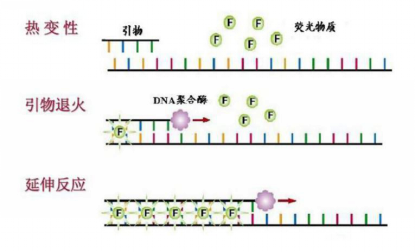
qPCR Dye Method
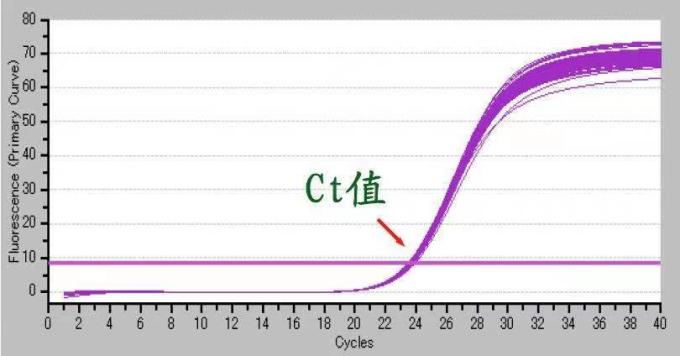
The CT value of each template has a linear relationship with the logarithm of the initial template concentration; the higher the initial concentration, the smaller the CT value. A standard curve can be made using standards of known initial concentration, in which the vertical axis represents the logarithm of the initial concentration and the horizontal axis represents the CT value. Based on the CT value obtained by fluorescence quantification of the sample to be tested, the initial concentration of that sample can be calculated from the standard curve.
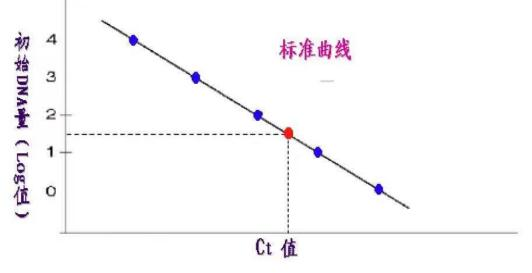
Standard Curve
The melting curve is used to verify the specificity of the amplification product. If the melting curve is a single peak (between 80 and 90°C), it indicates that there is only one product and the result is good; if it is a double peak (peaks between 70 and 80°C and between 80 and 90°C), it indicates that the product is not specific, and primer dimers or nonspecific amplification may be present.
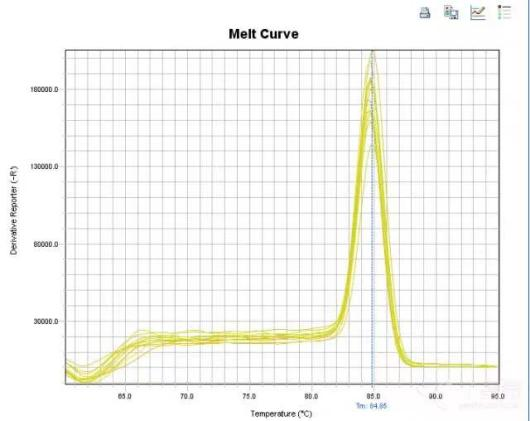
Melting Curve of a Normal Sample
Melting Curve of an Abnormal Sample
Based on the data generated by the qPCR detection system, combined with the standard curve and melting curve, the initial template concentration can be obtained after data processing.
Features of the qPCR Dye Method
The dye method is economical and affordable, but because the dye emits light whenever it binds to double-stranded DNA, its specificity is not strong, and a melting curve is needed to observe its specificity.
In a high-throughput sequencing laboratory (taking blood samples as an example), genomic DNA is extracted using a nucleic acid extraction kit, and then the genomic DNA is fragmented, assembled, and recombined to prepare a remodeled DNA model, namely a gene library. To perform quality testing of the library construction product, qPCR fluorescent dye technology is used, and this technology belongs to the relative quantification method.
qPCR Probe Method
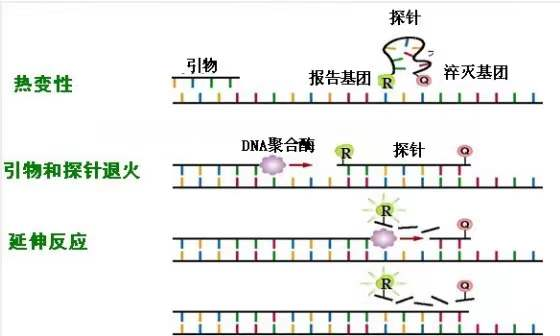
The PCR reaction system contains a pair of primers and a specific fluorescent probe. The probe is a specific oligonucleotide sequence, with one end labeled with a fluorescent reporter group and the other end labeled with a fluorescent quencher group. When the probe is intact, the fluorescence signal emitted by the reporter group is absorbed by the quencher group, and no fluorescence is emitted. During PCR amplification, DNA polymerase uses the exonuclease activity of the enzyme to cleave and degrade the probe, separating the reporter group from the quencher group and emitting fluorescence. Finally, the signal is monitored and detected by the qPCR instrument.
qPCR Probe Method
Based on the amplification curve generated by the fluorescence quantitative detection system, the CT value of the sample is read. According to the result interpretation principles, accurate result interpretation is performed for each sample.
Fluorescence Quantitative CT Value
The probe method collects signals only from the fragment bound by the probe and has good specificity, but the cost of synthesizing probes is relatively high.
At present, with the development of the COVID-19 pandemic trend, China must both prevent and control imported cases from abroad and respond to locally newly added cases and asymptomatic infected persons. Nucleic acid testing has become the most reliable method for diagnosing SARS-CoV-2 infection. Because the qPCR dye method cannot specifically identify DNA fragments, the best technology for nucleic acid testing is the RT-qPCR probe method.
SARS-CoV-2 nucleic acid testing is a qualitative experiment; whether a site is detected can be determined simply based on the qPCR CT value. At present, the SARS-CoV-2 nucleic acid testing sites mainly include three conserved gene sequences in the viral genome, namely open reading frame 1ab (ORF1ab), the nucleocapsid protein (N) gene, and the envelope protein (E) gene as detection targets. According to the Laboratory Testing Technical Guidelines for Pneumonia Caused by Novel Coronavirus Infection (Second Edition) issued by the National Health Commission, to confirm a case as positive in the laboratory, the specific real-time fluorescent RT-PCR test results for both targets, ORF1ab and the N gene of SARS-CoV-2, in the same sample must both be positive.

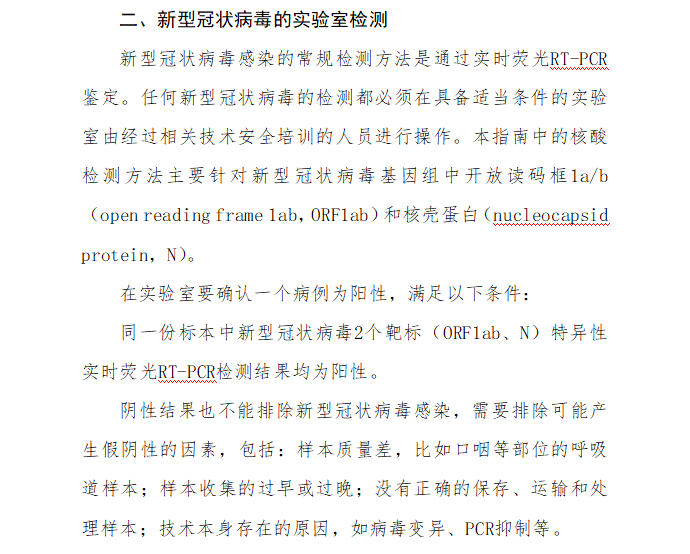
Image source: Official website of the National Health Commission
Negative: no Ct value or Ct value >40.
Positive: Ct value <37, can be reported as positive.
Indeterminate: Ct value between 37-40, repeat testing is recommended. If Ct value <40 and the amplification curve shows a clear peak, the sample is judged as positive; otherwise, it is negative.
Currently, the domestic PCR market has seen tremendous growth due to the COVID-19 pandemic, and the industry's prosperity has risen. With the development of epidemic prevention and control, the shortcomings of insufficient testing capacity at the grassroots level have been exposed. The Health Commission has repeatedly issued policies requiring strengthened laboratory construction and enhanced nucleic acid testing capabilities. Broad market demand, expanded application scope and reduced costs brought about by rapid technological iteration and upgrading, along with accompanying government support, have led to rapid growth in the PCR market size. The PCR industry occupies a golden track in molecular diagnostics, and the market size is expected to maintain high growth over the long term. Although digital PCR has emerged, it is still in the exploratory stage in clinical applications. Therefore, qPCR technology will continue to play an important role in the future molecular diagnostics market.